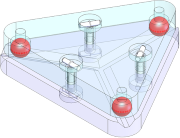
Modeling and Design of a Kinematic Mount in CAD (Using SolidWorks)
Kinematic mounts are one of the most powerful tools in precision machine design and optomechanical...
Read More
Kinematic mounts are one of the most powerful tools in precision machine design and optomechanical...
Read More
Split clamps are a simple, robust method for securing cylindrical components that need to be adjusted axially (e.g., focusing a lens) or rotationally (e.g., a prism holder or an adjustment screw). In both of these cases, the split clamp satisfies one of the principles of a good locking mechanism:
A locking mechanism’s action should not influence the sensitive adjustment that it is intended to secure.
Read More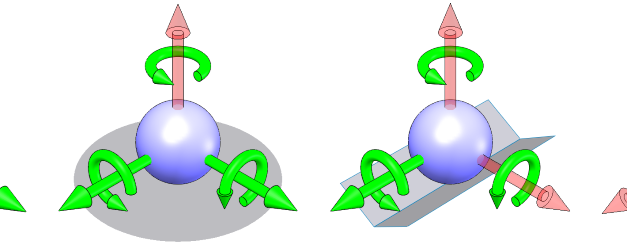
The advantage of a kinematic mount is that it locates one rigid body relative to another with very high repeatability, without over-constraining the body or introducing instability. It accomplishes this by using the precise number (and arrangement) of contact points needed to allow the desired degrees of freedom – no more and no less. That is the principle of kinematic constraint, which this article will show how to apply in your designs.
Read More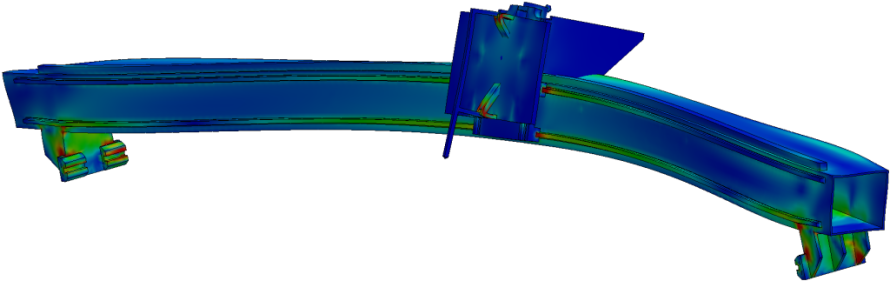
Precision machine design and optomechanical engineering are the domain of deflection – designing a thing so it can hold a position, move to a position, or follow a position with a level of accuracy that is many orders of magnitude smaller than the size of the thing itself.
Read More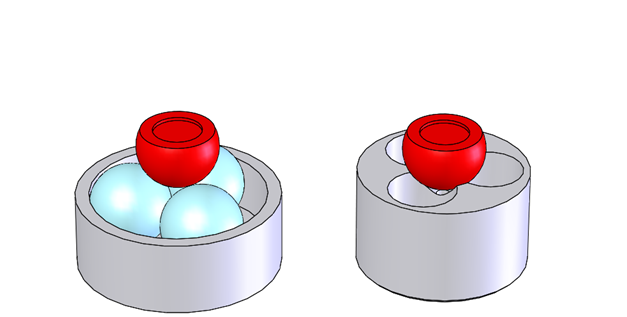
Kinematic mounting is the concept of locating and orienting a rigid body by no more than N points of contact, where (6 – N) is the remaining number of degrees of freedom (DOF). A trihedral socket provides exactly three points of contact, leaving the three rotational degrees of freedom, like a traditional ball and socket joint but with much higher precision. But a trihedral socket can be difficult to machine. This article discusses a number of methods for fabricating a trihedral socket that can produce both true and approximate kinematic mounting, for use in both precision machine design and optomechanical engineering applications.
Read More