Selecting Materials for Kinematic Components
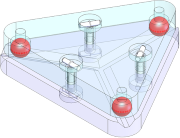
Kinematic components are the set of balls, vees, and other shapes that come into point...
Read More

Kinematic components are the set of balls, vees, and other shapes that come into point...
Read More
What is precision engineering? What fundamental difference sets it apart from “traditional” mechanical engineering, and how can that understanding help make your precision design a success?
Read More
Designing a successful precision machine or instrument depends on understanding accuracy, repeatability, and resolution – and especially the limiting relationship between accuracy and repeatability.
Read MoreKinematic mount design can be complicated. But it doesn’t have to be. This visual how-to guide highlights the decisions, criteria, and calculations involved in designing a robust, highly repeatable kinematic mount. Color-coding...
Read MoreIn this video, we look at how to layout a kinematic mount and optimize the design for stability...
Read MoreKinematic mounts are one of the most powerful tools in precision machine design and optomechanical...
Read More
Split clamps are a simple, robust method for securing cylindrical components that need to be adjusted axially (e.g., focusing a lens) or rotationally (e.g., a prism holder or an adjustment screw). In both of these cases, the split clamp satisfies one of the principles of a good locking mechanism:
A locking mechanism’s action should not influence the sensitive adjustment that it is intended to secure.
Read More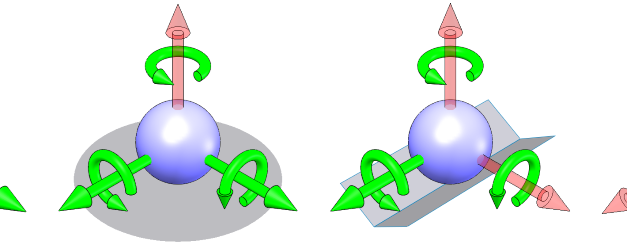
The advantage of a kinematic mount is that it locates one rigid body relative to another with very high repeatability, without over-constraining the body or introducing instability. It accomplishes this by using the precise number (and arrangement) of contact points needed to allow the desired degrees of freedom – no more and no less. That is the principle of kinematic constraint, which this article will show how to apply in your designs.
Read More